This is how we resolve problems in Florida

Now there’s jurisprudence in our local court.  Come to think of it, I rather like it.

This matter comes before the Court on Plaintiff’s Motion to designate location of a Rule 30(b)(6) deposition (Doc. 105). Upon consideration of the Motion – the latest in a series of Gordian knots that the parties have been unable to untangle without enlisting the assistance of the federal courts – it is

ORDERED that said Motion is DENIED. Instead, the Court will fashion a new form of alternative dispute resolution, to wit: at 4:00 P.M. on Friday, June 30, 2006, counsel shall convene at a neutral site agreeable to both parties. If counsel cannot agree on a neutral site, they shall meet on the front steps of the Sam M. Gibbons U.S. Courthouse, 801 North Florida Ave., Tampa, Florida 33602. Each lawyer shall be entitled to be accompanied by one paralegal who shall act as an attendant and witness. At that time and location, counsel shall engage in one (1) game of “rock, paper, scissors.” The winner of this engagement shall be entitled to select the location for the 30(b)(6) deposition to be held somewhere in Hillsborough County during the period July 11-12, 2006. If either party disputes the outcome of this engagement, an appeal may be filed and a hearing will be held at 8:30 A.M. on Friday, July 7, 2006 before the undersigned in Courtroom 3, George C. Young United States Courthouse and Federal Building, 80 North Hughey Avenue, Orlando, Florida 32801.

DONE and ORDERED in Chambers, Orlando, Florida on June 6, 2006.

Link here.

Alex Eckelberry

Even if a teller says it’s ok, it still may not be

Tedd Richardson has a good post about fraud:

Just because someone at the bank tells you a check is good, it might not be the case. Here is a story written by Caroline Mayer of the Washington Post, where someone selling a car on a auction site received a check for more than the amount of the purchase and was asked to wire the excess funds back. The seller was suspicious and asked a teller at his bank (twice) to verify the check and was told it was good. Here is what happened next as Caroline Mayer reports: “Four days later, as he reviewed his account online, he discovered the check was not good. Even worse, the bank was demanding that he repay the $5,000.”

Link here.

Alex Eckelberry

No, there s not a net-neutrality problem at Cox

Some Cox subscribers might be having a tough time getting to Craigslist

Instantly, rumors started that Cox was doing a net-neutrality thing — throttling bandwidth to the site to stifle competition against their own print classified business.

Well, it turns out the problem is a lot simpler (and considerably less nefarious): It’s related to the AV/firewall suite that Cox license from Authentium.  Since we do business with Authentium, I thought I would contact them to get an explanation.

Here’s what happened: Craigslist does the unusual step of sending a TCP packet with a zero-length window (typically used to indicate that that the server is experiencing congestion and can’t handle more data). 

Those subscribers running the suite will experience delays in getting to the site, since Authentium’s firewall responds to the zero-length window by sending data only one byte at a time, even after the server increases the TCP window size.

Authentium is on it and is fixing the problem.

The whole thing is explained here by Ray Dickenson of Authentium. 

Alex Eckelberry

CastleCops under heavy attack

A while back, Paul and Robin Laudanski and I started PIRT, and the results have been strong.  The PIRT volunteer staff is taking down lots of phishing sites.

I guess it’s been working and pissing off some phishers, because CastleCops has been under heavy DDoS attack.

Things are back to normal, and Paul will be writing something up a bit later as a forensic investigation is still in progress.  

Alex Eckelberry

PornMagPass — your pass to hell

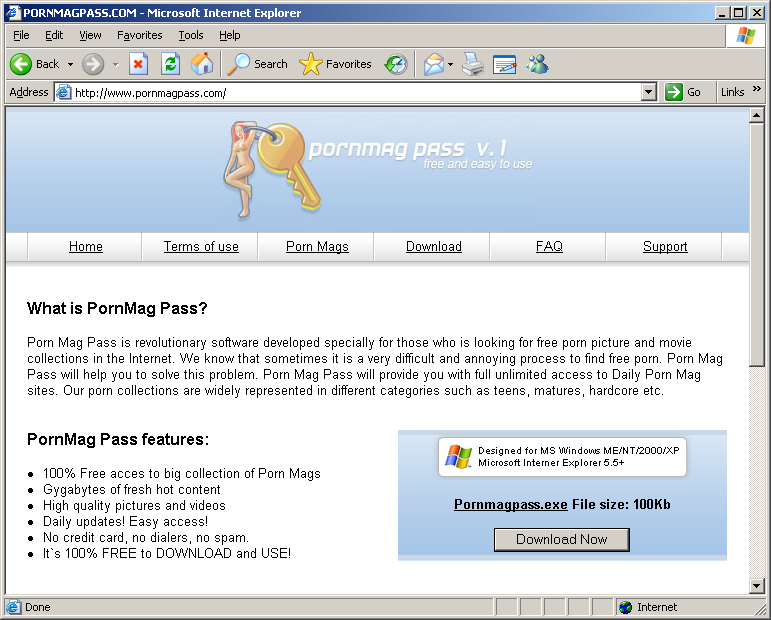
There’s a new trojan on the loose, undetected by almost all AV engines:  Pornmagpass, from pornmagpass(dot)com.

Pornmagpass_0001

Install it as a “free” ticket to porn. After all, the FAQ says “It is 100% free. No catch.”

But… the EULA says:

SOFTWARE INSTALLATION: Components bundled with our software may report to Licensor and/or its affiliates the installation status of certain marketing offers, such as toolbars, and also generalized installation information, such as language preference and operating system version, to assist Licensor in its product development. No personal information will be communicated to PORNMAGPASS or its affiliates during this process. Licensor may change homepage on user’s computer and may offer additional components through our version of checking/update system. These components include: toolbar, popup ads manager, advertisements messenger, pc protection software, shortcuts manager.

Well, well.

Install it, and this trojan will install rogue security app SpywareQuake and adds a new IE Toolbar called “Safety Bar”

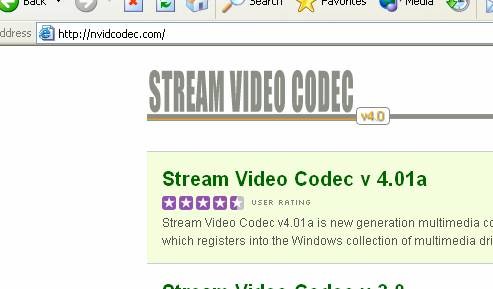
Pornmag_1023

To mangle a common phrase, the pass to hell is littered with porn. In this case, PornMagPass.

And as a final note, yet another malware site hosted by Intercage, the Best Friend Ever of all malware authors. 


Alex Eckelberry
(And thanks to Sunbelt’s Adam Thomas for his work on this)

The LAMP controversy

The idea of LAMP (which stands for Linux, Apache, MySQL and PHP) has its share of detractors. Cliff Wells is one of them, and writes an interesting rant on the subject.

PHP and MySQL are this generation’s BASIC, the language that was described thusly by the Free Online Dictionary of Computing

BASIC has become the leading cause of brain-damage in proto-hackers. This is another case (like Pascal) of the cascading lossage that happens when a language deliberately designed as an educational toy gets taken too seriously. A novice can write short BASIC programs (on the order of 10-20 lines) very easily; writing anything longer is (a) very painful, and (b) encourages bad habits that will make it harder to use more powerful languages well. This wouldn’t be so bad if historical accidents hadn’t made BASIC so common on low-end micros. As it is, it ruins thousands of potential wizards a year. [ed — possibly mis-attributed quote. ]

Link here via /. And the comment storm is epic on this one, so I know I’m stepping feet-first into the fire.

I’m not going to comment on code. We have coders here who love PHP and those who don’t. .

But focusing on the security perspective, LAMP can be a deadly combination. Let’s face it: People get sloppy with security policies for Apache, MySQL and PHP. I can’t believe the amount of crap I see out there that’s only in existence because of loose security and poor (or more likely, non-existent) patching practices.

We use PHP ourselves in our beta forums. But it gets tiring dealing with open source in a commercial environment. PHP is routinely exploited and we have to constantly stay on top of our code to keep it updated and secure.

I do understand the other side — so many people have gotten their start with some quick PHP scripts and MySQL. Look at Paul Laudanski at CastleCops and Suzie Turner at SpywareWarrior — both have created robust, highly secure PHP-based sites (and in the case of Paul, he’s admirably stretched MySQL to its absolute limits).

And, yes, any language can be mis-used and exploited.

So before the comment storm starts, I am not bashing Perl, Python or PHP. I’m not bashing Apache (well, not really…). And dear God, I’m not bashing Linux, or else I know that my website will be blown up by Microsoft-hating vigilantes.

It’s just like this: Like any tools (including, umm, chainsaws), one has to know how to use them and be responsible for their use.

I’ve seen way, way too many hacked Apache servers not to say something.

Alex Eckelberry

Sunbelt TechTips for the week of June 5

How to enable and use the secondary logon service

Many PC users log onto their systems with administrative accounts all the time, because they need to be able to run certain programs or perform tasks that require administrative privileges and don’t want to have to log off and log back on with an admin account to do so. But running as an administrator puts your system at risk. You might not realize that Windows XP has a feature called secondary logon that allows you to run a program using an admin account when you’re logged on with an account with lesser privileges. Here’s how to enable the service and use it with a shortcut.

  1. To enable secondary logon, you must first log on as an administrator. Then right click My Computer and select Manage.
  2. In the Computer Management console, expand Services and Applications and select Services.
  3. In the right pane, right click Secondary Logon and select Properties.
  4. In the Properties dialog box, select Automatic for Startup Type and then click Start.
  5. Click OK and close the Computer Management console.
  6. To use secondary logon with a program shortcut, first locate the shortcut in the Programs menu, then press the SHIFT key while right clicking the shortcut and select Run as.
  7. In the Run as dialog box, click the following user option, then enter the user name and password for the admin account you want to use to run the program and click OK.

Can’t view source code on web pages
If you find yourself unable to “View source” to see the source code of a web page in Internet Explorer, one fix is to delete the temporary Internet files, but that may not work for everyone.

A full cache is the most common reason for a sudden inability to view the source, but there are other things that can cause this. If you have somehow deleted Notepad.exe, you will no longer be able to view the source since IE uses Notepad to view the text files that make up the source code. In Windows Explorer, check the WINDOWS folder to see if the Notepad.exe application file is there (you may have to change your folder view settings to allow you to view the files in this folder). Normally XP won’t let you delete system files like Notepad.exe but it’s possible that it has been corrupted. Try copying Notepad.exe from another XP computer into your WINDOWS directory. It can also happen if your cookies folder is on an NTFS partition and you don’t have the proper permissions (Change) to the folder. It could also be that you just got impatient; you may not be able to view the source if the page hasn’t downloaded completely. It’s also possible for an administrator to restrict you from viewing source code by editing the registry.

New Window displays blank white page
When you open a new window in Internet Explorer 6, do you get a blank white page instead of the web site you were expecting? You might also get an error message (Error 49) if you try to do a search on the page with the Find command. This is caused by IE DLL files that aren’t registered correctly. Luckily, it’s fairly easy to register these files using the command line utility regsvr32. For instructions on how to do so, see KB article 902932.

The connection between your XP computer and Windows Mobile 5 device is lost
You connect your Windows Mobile 5 smart phone or handheld computer to your Windows XP desktop computer via USB to synchronize files or install software on the mobile device, but you may find that your connection is being intermittently lost, which can cause all manner of problems if it happens during a download or synchronization process. This happens when the XP computer has service pack 1 installed and has an EHCI USB 2.0 host controller attached. The good news is that there’s a hotfix (USB 1.1 and 2.0 update) that should resolve the problem. For more info and a link to get the fix, see KB article 902270.

Windows validation check won’t complete
The Windows Genuine Advantage (WGA) program requires that your system be checked to ensure it’s running a legal copy of Windows XP or 2000 before you can download some software from the Microsoft web site. However, you may try to validate your copy of Windows only to have the system hang and never complete the validation process. This may happen because you’ve blocked ActiveX controls from running on the computer for security reasons. WGA needs to be able to run ActiveX. For instructions on how to reenable ActiveX in Internet Explorer, see KB article 905226.

Deb Shinder

Will Paper Soon be a Thing of the Past?

Tech types have been predicting for decades that the end of the paper era is at hand. Remember how computers were going to lead to the “paperless office?” Yet it seems that today, with computers everywhere, we generate more paper than ever before. Many states in the U.S. have passed laws recognizing the legality of digital signatures, but for a lot of folks, “having it in writing” still means a “hard copy” – and if we get an important document in electronic format, the first thing we do is print it out so we’ll have a “real” copy to stash in the fire-proof file cabinet.

Many of the companies with which I work – most of which are in the tech industry – still send contracts via snail mail and require paper copies with original signatures even though all the rest of our correspondence and submission of work is done via email.

This distrust of electronic information is probably based on past experience with its sometimes ephemeral nature. Who among us hasn’t ever experienced the frustration of losing important computer files forever due to a software glitch or hardware failure? This “now you see it, now you don’t” aspect of electronic documents makes people nervous when those documents are important legal agreements. Sure, paper documents suffer from their own form of fragility – as anyone who’s lost the cash they stashed under the mattress to a fire can attest – but there’s something comforting about being able to hold that piece of paper in your hand.

I suspect it will be a long time (not in my lifetime) before the populace will accept purely electronic forms of things like employment contracts, marriage licenses, birth certificates, real estate deeds and other important “papers.” But what about the tons of more mundane pieces of paper that clutter up our daily lives? Is it really necessary to have a hundred (or in a large office, a thousand) copies of every corporate memo floating around? Could we take a load off our file cabinets – not to mention our wastebaskets – if we posted routine info such as price lists and standard operating procedures on intranet web sites instead of distributing paper manuals? Would security be improved (along with the need for heavy duty shredders) if we disallowed printing of sensitive information and instead kept it in encrypted computer files?

But it’s not just at the office that paper is being (albeit very slowly) replaced. I wonder how many people there are out there who, like me, no longer subscribe to their local newspapers because they can read it on the web instead? I love not having to fill up the recycle bin with all those old newspapers every week. If you have a kitchen computer (or just a laptop), you can easily bring up recipes on screen when you need them and not have to store bunches of recipe cards or cookbooks. Even this newsletter you’re reading is a case in point; ten years ago I was still getting computer tips newsletters in the mail; now they’re all distributed via email or the web.

Some other replacements for paper have had a harder time catching on. Take ebooks, for example. It’s a wonderful idea: I can carry the equivalent of a hundred or more novels or reference books on vacation with me, stored on a tiny flash memory card. If I want to find a particular scene or description that I read many pages ago, I can use search software to go to it quickly and easily. I can mark where I left off reading without turning down the edges of pages or dealing with bookmarks that fall out.

So why aren’t electronic books wildly popular? It’s not for lack of trying. Publishers have marketed ebooks as PDFs, Microsoft has its own (very functional) Reader software for both PCs and handheld (Pocket PC) computers, and at least a dozen companies have tried, over the years, to sell dedicated ebook reading devices that are more compact and less costly than a full fledged computer.

The most recent attempt to cash in on this market comes from Sony, which this summer is releasing a device in the U.S. called Sony Reader to be sold through the SonyStyle.com web site and at Borders bookstores (it’s been on the market in Japan for a little over a year and is moderately successful there). It’s about the size of a paperback book (6.9″ x 4.9″ x .5″) and weight about half a pound. The question is whether it will overcome the obstacles that have prevented previous ebook readers from gaining popularity.

Common complaints about readers included short battery life (imagine avidly reading the latest thriller and having the pages all suddenly go blank during an exciting scene), high cost, and proprietary formats. Sony seems to have addressed the first, with a battery that reportedly will last through up to 7500 page turns per charge. With a price between $300 and $400, though, consumers may still balk. In my opinion, in order to gain a real following, an ebook reader is going to need to retail for around $150 or less. Some argue that consumers are paying nearly $400 for the highest end ipods – but I’m not sure the book reading public is ready to shell out to the same degree as the music listening/video watching public. Of course, I could be wrong.

Probably the biggest cause for failure of earlier reading devices was the lack of a standardized file format. The ebook you bought for one device couldn’t be viewed on another company’s reader. And only a limited number of books were available in each format. If you bought a book in .lit (Microsoft Reader) format, you couldn’t read it on your Franklin eBookMan. Another big concern for those of us who like to keep and re-read our books is digital rights management (DRM). As with digital music, ebooks are often coded with limitations intended to prevent copyright violations but which also interfere with a legitimate purchaser’s ability to use the files.

In fact, DRM was the downfall of Sony’s earlier ebook reader. They released the Libre in 2004 and it was hailed for its excellent screen display, but a business model that only allowed you to keep the ebooks you purchased for 60 days (after which they locked up and couldn’t be read) ensured a less than enthusiastic reception in the marketplace. The new Sony Reader supports PDF, TXT, and RTF file formats (and can convert Microsoft DOC files to RTF) along with its own Broadband eBook (BBeB) format. Its new and improved DRM lets you keep the ebooks indefinitely and share them between 6 devices.

What do you think? Are we getting closer to a paperless world? Will it ever happen? Are you using less paper these days – or more? Would you substitute an ebook reader for “real books” if the price was right? Why or why not?

Deb Shinder

More on 180Solutions and Hotbar

Nice work, Wayne… this is quite interesting.

Now there are articles hitting mainstream press covering the proposed deal, and we can point readers to a rough translation of an article that Google News snagged out of Israel: Hotbar in talks for sale to 180Solutions at Globes.co.il

The article says :

Israeli dot.com company Hotbar Inc. is negotiating its sale at a company value of $52 million. The probably buyer is Internet company 180Solutions Inc.. Sources inform ”Globes” that Hotbar is also negotiating with other companies, including ICQ. Hotbar develops software that sits on the browser, enabling users to change their toolbar to include links to services the company offers. Founded in 1999 by CEO Oren Dobronsky and president Gabriella Karni, the company has raised $15 million to date. Its last financing round was held in 2001. Investors include Eurofund, Tamar technology Ventures, Technorov Holdings, CE Unterberg Towbin, and Deutsche Bank subsidiary ABS Ventures. According to IVC Online, the company had $35 million in sales in 2004.

180Solutions develops software solutions for on-line advertising. The company develops adware, otherwise known as spyware, activities hated by surfers and users of computers. Coincidently or not, this activity is connected to a lawsuit anti-virus developer Symantec Corp. (Nasdaq:SYMC) filed a year ago against Hotbar, in which Symantec demanded that some of Hotbar’s activities be classified as adware. the case was settled out of court a few months ago.

Some of this article seems completely off base and some of the connections are a pretty far stretch. For example, it is hard to discern how the Symantec suit had anything to do with a deal like this being brokered- although the article does reference it as a possible “coincidence”.

Link here.

Alex Eckelberry


Features flinging off of Vista and Office 2007 faster than (insert metaphor here)

Vista and Office 2007 are losing PDF and XPS.  Vista is losing PC-to-PC sync.

XPS, the XML-based printer specification format, competes with Adobe, possibly the reason why Adobe is so grumpy at Microsoft (hence, PDF is toast).  XPS will still be in Vista, just “under the hood”.   

PC-to-PC sync is also toast.

More from Paul Thurrott.

Alex Eckelberry

Meg Whitman emails users about net neutrality

PowSelleBayU_Meg

A pretty interesting move, eBay’s CEO has emailed about a million eBay users, arguing for net neutrality.  The email starts like this:

As you know, I almost never reach out to you personally with a request to get involved in a debate in the U.S. Congress. However, today I feel I must.

Right now, the telephone and cable companies in control of Internet access are trying to use their enormous political muscle to dramatically change the Internet. It might be hard to believe, but lawmakers in Washington are seriously debating whether consumers should be free to use the Internet as they want in the future.

You can read the email here, plus a CNET article here.

Confused or curious about net neutrality?  We’ve written an analysis here which I recommend reading. 

Alex Eckelberry

Will 180solutions buy Hotbar?

180log_0001Hotbar_000001

180Solutions was reportedly in negotiations to purchase Hotbar back in March.  The deal, which was said to be primarily the assumption of Hotbar’s debt, was perhaps an opportunity to give 180Solutions a hedge against its changing business model, with rapidly declining install rates as a result of no longer distributing through IST and the company’s decision to drop third party affiliate networks (by late Q1, 180’s daily revenue had reportedly dropped to approximately $75k a day, whereas a year ago that number was closer to $200k per day). 

180 was also reportedly interested in purchasing the assets of Claria’s adware business, and I wouldn’t be surprised if a deal occurred there, as in my opinion, 180 is still the most logical buyer for that business. 

However, cash has been a problem for 180solutions: Despite having raised a $40 million from Spectrum Equity Investors two years ago, a fair amount of that money went to the company’s founders, Daniel Todd and (reportedly) Keith Smith. With the company’s precipitous decline in install rates, cash has been at a premium (recently, however, one source with the company was said to have claimed that install rates are up and things are doing well).  What with Segways, stunning offices, plasma screens and a bevy of beautiful people and big salaries, one is not surprised.

Today, we learned from an anonymous source that this deal is imminent and could happen in the next several weeks.  Possibility?  Who knows.  At this point, this is rumour and conjecture, but it is all rather interesting.

Alex Eckelberry

Sunbelt’s sister company acquired

Today, DoubleTake Software announced the acquisition of our sister company, Sunbelt System Software (SSS).  

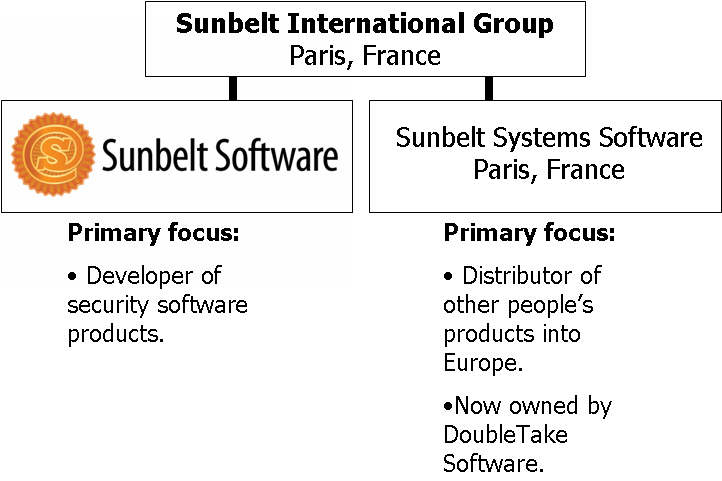
To put the acquisition into context, it helps to understand our corporate framework:  French-based Sunbelt International Group owns two companies: Sunbelt Software (which I run) and Sunbelt System Software (run by Jo Murciano). 

Unlike Sunbelt Software, SSS is a pure distributor of other company’s products.  They develop nothing.  They are basically a sales, technical support and marketing organization.  They distribute our products into Europe, but their primary focus is distributing DoubleTake Software’s products.

Here’s a picture:

Corp_struct

So for us, this is a logical acquisition, given that Sunbelt System Software was a close partner of DoubleTake Software and was heavily focused on selling that company’s product line. 

This acquisition means that we now will be setting up our own European distribution channels. 
  
For now, nothing changes.  SSS will still continue to support and sell our products.  We will start a methodical transition over the coming months so that our European activities are fully managed by us, right here in Clearwater.
 
The bottom line is that this is good news for us, and I’m excited by what the future holds for us in Europe.
 
 
Alex